

TV Input Framework (TIF) 管理器與音頻路由 API 一起使用,以支持靈活的音頻路徑更改。當片上系統 (SoC) 實現電視硬件抽象層 (HAL) 時,每個電視輸入(HDMI IN、調諧器等)都會提供TvInputHardwareInfo ,用於指定音頻類型和地址的 AudioPort 信息。
- 物理音頻輸入/輸出設備具有相應的 AudioPort。
- 軟件音頻輸出/輸入流表示為 AudioMixPort(AudioPort 的子類)。
然後 TIF 將 AudioPort 信息用於音頻路由 API。
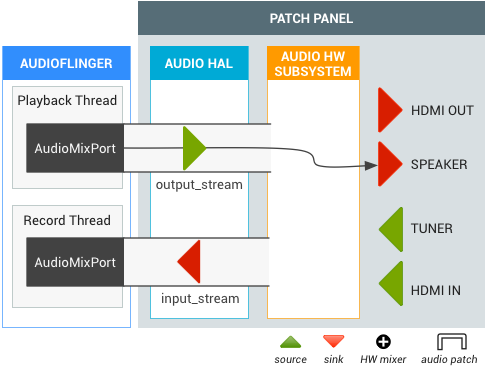
圖 1. TV 輸入框架 (TIF)
要求
SoC 必須使用以下音頻路由 API 支持來實現音頻 HAL:
| 音頻端口 |
|
|---|---|
| 默認輸入 | AudioRecord(使用 DEFAULT 輸入源創建)必須為 Android TV 上的 AUDIO_DEVICE_IN_DEFAULT 獲取獲取虛擬空輸入源。 |
| 設備環回 | 需要支持 AUDIO_DEVICE_IN_LOOPBACK 輸入,該輸入是所有電視輸出(11Khz、16 位單聲道或 48Khz、16 位單聲道)的所有音頻輸出的完整混合。僅用於音頻捕獲。 |
電視音頻設備
Android 支持以下音頻設備用於電視音頻輸入/輸出。
system/media/audio/include/system/audio.h
注意:在 Android 5.1 及更早版本中,該文件的路徑為: system/core/include/system/audio.h
/* output devices */
AUDIO_DEVICE_OUT_AUX_DIGITAL  = 0x400,
AUDIO_DEVICE_OUT_HDMI   = AUDIO_DEVICE_OUT_AUX_DIGITAL,
/* HDMI Audio Return Channel */
AUDIO_DEVICE_OUT_HDMI_ARC   = 0x40000,
/* S/PDIF out */
AUDIO_DEVICE_OUT_SPDIF    = 0x80000,
/* input devices */
AUDIO_DEVICE_IN_AUX_DIGITAL   = AUDIO_DEVICE_BIT_IN | 0x20,
AUDIO_DEVICE_IN_HDMI      = AUDIO_DEVICE_IN_AUX_DIGITAL,
/* TV tuner input */
AUDIO_DEVICE_IN_TV_TUNER    = AUDIO_DEVICE_BIT_IN | 0x4000,
/* S/PDIF in */
AUDIO_DEVICE_IN_SPDIF   = AUDIO_DEVICE_BIT_IN | 0x10000,
AUDIO_DEVICE_IN_LOOPBACK    = AUDIO_DEVICE_BIT_IN | 0x40000,
音頻 HAL 擴展
音頻路由 API 的音頻 HAL 擴展定義如下:
system/media/audio/include/system/audio.h
注意:在 Android 5.1 及更早版本中,該文件的路徑為: system/core/include/system/audio.h
/* audio port configuration structure used to specify a particular configuration of an audio port */
struct audio_port_config {
    audio_port_handle_t      id;           /* port unique ID */
    audio_port_role_t        role;         /* sink or source */
    audio_port_type_t        type;         /* device, mix ... */
    unsigned int             config_mask;  /* e.g AUDIO_PORT_CONFIG_ALL */
    unsigned int             sample_rate;  /* sampling rate in Hz */
    audio_channel_mask_t     channel_mask; /* channel mask if applicable */
    audio_format_t           format;       /* format if applicable */
    struct audio_gain_config gain;         /* gain to apply if applicable */
    union {
        struct audio_port_config_device_ext  device;  /* device specific info */
        struct audio_port_config_mix_ext     mix;     /* mix specific info */
        struct audio_port_config_session_ext session; /* session specific info */
    } ext;
};
struct audio_port {
    audio_port_handle_t      id;                /* port unique ID */
    audio_port_role_t        role;              /* sink or source */
    audio_port_type_t        type;              /* device, mix ... */
    unsigned int             num_sample_rates;  /* number of sampling rates in following array */
    unsigned int             sample_rates[AUDIO_PORT_MAX_SAMPLING_RATES];
    unsigned int             num_channel_masks; /* number of channel masks in following array */
    audio_channel_mask_t     channel_masks[AUDIO_PORT_MAX_CHANNEL_MASKS];
    unsigned int             num_formats;       /* number of formats in following array */
    audio_format_t           formats[AUDIO_PORT_MAX_FORMATS];
    unsigned int             num_gains;         /* number of gains in following array */
    struct audio_gain        gains[AUDIO_PORT_MAX_GAINS];
    struct audio_port_config active_config;     /* current audio port configuration */
    union {
        struct audio_port_device_ext  device;
        struct audio_port_mix_ext     mix;
        struct audio_port_session_ext session;
    } ext;
};
hardware/libhardware/include/hardware/audio.h
struct audio_hw_device {
  :
    /**
     * Routing control
     */

    /* Creates an audio patch between several source and sink ports.
     * The handle is allocated by the HAL and should be unique for this
     * audio HAL module. */
    int (*create_audio_patch)(struct audio_hw_device *dev,
                               unsigned int num_sources,
                               const struct audio_port_config *sources,
                               unsigned int num_sinks,
                               const struct audio_port_config *sinks,
                               audio_patch_handle_t *handle);

    /* Release an audio patch */
    int (*release_audio_patch)(struct audio_hw_device *dev,
                               audio_patch_handle_t handle);

    /* Fills the list of supported attributes for a given audio port.
     * As input, "port" contains the information (type, role, address etc...)
     * needed by the HAL to identify the port.
     * As output, "port" contains possible attributes (sampling rates, formats,
     * channel masks, gain controllers...) for this port.
     */
    int (*get_audio_port)(struct audio_hw_device *dev,
                          struct audio_port *port);

    /* Set audio port configuration */
    int (*set_audio_port_config)(struct audio_hw_device *dev,
                         const struct audio_port_config *config);
測試 DEVICE_IN_LOOPBACK
要測試 DEVICE_IN_LOOPBACK 以進行電視監控,請使用以下測試代碼。運行測試後,捕獲的音頻保存到/sdcard/record_loopback.raw ,您可以在其中使用FFmpeg收聽。
<uses-permission android:name="android.permission.MODIFY_AUDIO_ROUTING" />
<uses-permission android:name="android.permission.WRITE_EXTERNAL_STORAGE" />

   AudioRecord mRecorder;
   Handler mHandler = new Handler();
   int mMinBufferSize = AudioRecord.getMinBufferSize(RECORD_SAMPLING_RATE,
           AudioFormat.CHANNEL_IN_MONO,
           AudioFormat.ENCODING_PCM_16BIT);;
   static final int RECORD_SAMPLING_RATE = 48000;
   public void doCapture() {
       mRecorder = new AudioRecord(MediaRecorder.AudioSource.DEFAULT, RECORD_SAMPLING_RATE,
               AudioFormat.CHANNEL_IN_MONO, AudioFormat.ENCODING_PCM_16BIT, mMinBufferSize * 10);
       AudioManager am = (AudioManager) getSystemService(Context.AUDIO_SERVICE);
       ArrayList<AudioPort> audioPorts = new ArrayList<AudioPort>();
       am.listAudioPorts(audioPorts);
       AudioPortConfig srcPortConfig = null;
       AudioPortConfig sinkPortConfig = null;
       for (AudioPort audioPort : audioPorts) {
           if (srcPortConfig == null
                   && audioPort.role() == AudioPort.ROLE_SOURCE
                   && audioPort instanceof AudioDevicePort) {
               AudioDevicePort audioDevicePort = (AudioDevicePort) audioPort;
               if (audioDevicePort.type() == AudioManager.DEVICE_IN_LOOPBACK) {
                   srcPortConfig = audioPort.buildConfig(48000, AudioFormat.CHANNEL_IN_DEFAULT,
                           AudioFormat.ENCODING_DEFAULT, null);
                   Log.d(LOG_TAG, "Found loopback audio source port : " + audioPort);
               }
           }
           else if (sinkPortConfig == null
                   && audioPort.role() == AudioPort.ROLE_SINK
                   && audioPort instanceof AudioMixPort) {
               sinkPortConfig = audioPort.buildConfig(48000, AudioFormat.CHANNEL_OUT_DEFAULT,
                       AudioFormat.ENCODING_DEFAULT, null);
               Log.d(LOG_TAG, "Found recorder audio mix port : " + audioPort);
           }
       }
       if (srcPortConfig != null && sinkPortConfig != null) {
           AudioPatch[] patches = new AudioPatch[] { null };
           int status = am.createAudioPatch(
                   patches,
                   new AudioPortConfig[] { srcPortConfig },
                   new AudioPortConfig[] { sinkPortConfig });
           Log.d(LOG_TAG, "Result of createAudioPatch(): " + status);
       }
       mRecorder.startRecording();
       processAudioData();
       mRecorder.stop();
       mRecorder.release();
   }
   private void processAudioData() {
       OutputStream rawFileStream = null;
       byte data[] = new byte[mMinBufferSize];
       try {
           rawFileStream = new BufferedOutputStream(
                   new FileOutputStream(new File("/sdcard/record_loopback.raw")));
       } catch (FileNotFoundException e) {
           Log.d(LOG_TAG, "Can't open file.", e);
       }
       long startTimeMs = System.currentTimeMillis();
       while (System.currentTimeMillis() - startTimeMs < 5000) {
           int nbytes = mRecorder.read(data, 0, mMinBufferSize);
           if (nbytes <= 0) {
               continue;
           }
           try {
               rawFileStream.write(data);
           } catch (IOException e) {
               Log.e(LOG_TAG, "Error on writing raw file.", e);
           }
       }
       try {
           rawFileStream.close();
       } catch (IOException e) {
       }
       Log.d(LOG_TAG, "Exit audio recording.");
   }
在/sdcard/record_loopback.raw中找到捕獲的音頻文件並使用FFmpeg收聽:
adb pull /sdcard/record_loopback.rawffmpeg -f s16le -ar 48k -ac 1 -i record_loopback.raw record_loopback.wavffplay record_loopback.wav
用例
本節包括電視音頻的常見用例。
帶揚聲器輸出的電視調諧器
當電視調諧器激活時,音頻路由 API 在調諧器和默認輸出(例如揚聲器)之間創建一個音頻補丁。調諧器輸出不需要解碼,但最終音頻輸出與軟件 output_stream 混合。
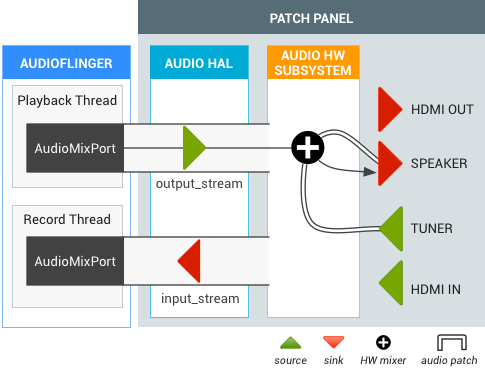
圖 2.帶有揚聲器輸出的電視調諧器音頻補丁。
直播電視期間的 HDMI OUT
用戶正在觀看直播電視,然後切換到 HDMI 音頻輸出 (Intent.ACTION_HDMI_AUDIO_PLUG) 。所有 output_streams 的輸出設備更改為 HDMI_OUT 端口,TIF 管理器將現有調諧器音頻補丁的 sink 端口更改為 HDMI_OUT 端口。
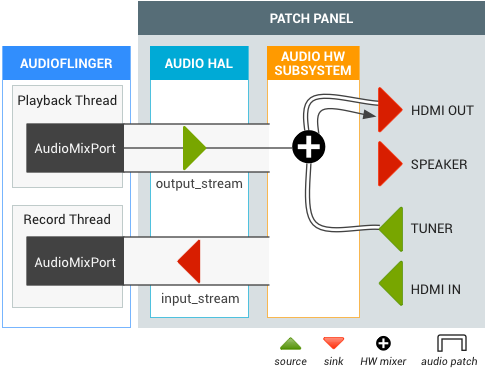
圖 3.來自直播電視的 HDMI OUT 音頻補丁。