
This page describes how to enable the audio framework and audio HAL (AHAL) to manage synchronous connection-oriented (SCO) connections, a process identified as Audio Managed SCO (AMSCO).
In Android 17 and higher, the Android audio framework uses the SCO management feature to manage SCO routing, which was originally handled by the Bluetooth (BT) framework. This migration moves the SCO connection status from a state owned by the BT framework to a downstream consequence of audio streaming activity.
By centralizing ownership of audio routing within the audio framework, this feature aligns the audio hardware abstraction layer (HAL) implementation for SCO with other BT profiles like Advanced Audio Distribution Profile (A2DP) and LE Audio. This refactor simplifies the interaction between the telecom and BT stacks, enabling a more robust and centralized audio routing architecture.
Architectural overview
The AMSCO architecture centralizes SCO connection management within the Android audio framework, which bases routing decisions on audio streaming activity. This architecture contrasts with the previous model where the BT stack managed connections. The roles of each component in this architecture are as follows:
The AHAL starts and suspends the SCO session only if the following conditions are met:
- An active stream is patched to a SCO device.
- The audio mode is set, and a patch to a SCO device exists.
The audio framework prevents an A2DP device from having a concurrent patch when these specific criteria are satisfied. The audio framework no longer sends SCO state changes or A2DP suspends to the AHAL.
The audio framework handles SCO management, so the BT stack no longer calls
connect or disconnect audio. In cases of preemptive SCO
disconnection or error, the BT stack informs the audio
framework with AudioManager#onHfpAudioDisconnected.
Plan
Use the information in this section to assess the following compatibility and architectural requirements before implementing the SCO management refactor.
Backward compatibility
To enable the framework to continue to support devices that might receive OS updates without updating their AHALs or BT AHALs, use a system property to indicate that the new SCO management must be enabled. The legacy path is preserved for up to six years in cases where the system property is disabled or the HAL version is out of date.
Set up the HFP session
The AHAL must use the new hands-free profile (HFP) session type to start or
suspend playback, similar to other BT session types. The stream state is
ultimately managed using different IBluetoothAudioProviders, which are
enumerated and built by a Factory class depending on the available pathways.
The BT stack uses a hardware offload path whenever possible. The preference for codecs during negotiation follows this order: LC3 hardware is preferred over LC3 software, followed by mSBC hardware, then mSBC software, and finally CVSD hardware is preferred over CVSD software.
The following sequence diagrams detail the interactions between the AHAL and the BT stack required to establish the stream state.
Hardware offload procedure
Figure 1 illustrates how the AHAL and BT stack coordinate to establish a direct hardware data path for SCO audio:

Figure 1. Hardware offload procedure.
Software data path procedure
Figure 2 illustrates the process for handling audio data that requires system software processing:

Figure 2. Software data path procedure.
Codec renegotiation procedure
When the audio gateway (AG) receives a new BT available codec (AT+BAC) command, the AG restarts the codec negotiation procedure. Figure 3 illustrates the codec renegotiation procedure:

Figure 3. Codec renegotiation procedure.
Impact on HeadsetStateMachine
The Java layer headset state machine (represented by the HeadsetStateMachine
class) remains largely unchanged with the
exception of the AUDIO_CONNECTED state, which is driven by native stack
events.
Within the Java layer, the system no longer initiates
connectAudioNative or disconnectAudioNative. Instead, the system responds
to audio connection state changes from the native stack. These changes are
triggered by the AHAL's commands on IBluetoothAudioProvider or
IBluetoothAudioPort.
Implementation
To integrate the SCO management refactor, update the communication between the BT stack and the audio framework.
Follow these steps to implement the feature:
Notify the audio framework about changes to the active BT to help with the proper management of SCO initiation and teardown during HFP device connections and to handle active device changes. Use
AudioManager.handleBluetoothActiveDeviceChanged(HfpInfo)to provide this information to the audio framework.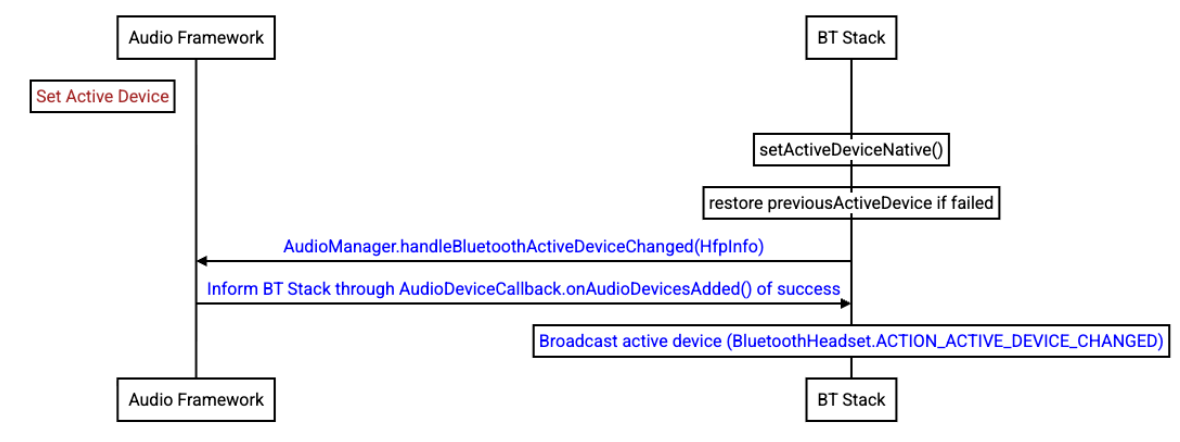
Figure 4. Connect HFP device.
The audio framework uses the
AudioManagerAudioDeviceCallback#onAudioDevicesAddedcallback instead of legacy broadcasts to indicate the audio device state.Implement AHAL stream control using
setCommunicationDevice(AudioDeviceInfodevice)as the primary control point to start the SCO connection.If
HfpTransport::StartRequestreturnsBluetoothAudioCtrlAck::PENDING, the AHAL must retry the request because the HFP state machine isn't established.
Use cases
The following sections outline typical critical user journeys (CUJs).
Telecom call flow
The SCO management refactor changes phoneStateChanged into a blocking
function. This modification causes telecom to wait for the
phoneStateChanged execution within the BluetoothInCallService.onCallAdded
method to complete before it invokes the audio framework API to start SCO
creation.
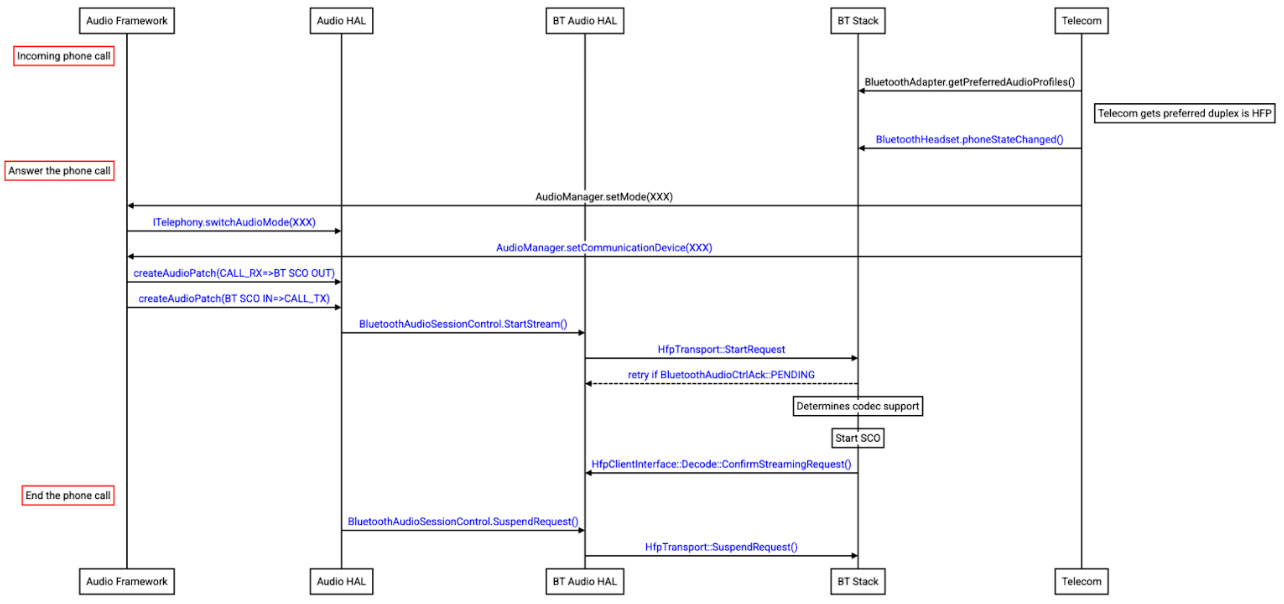
Figure 5. Answer or start a call through telecom.
VOIP call flow
The audio framework starts the process by calling the
BluetoothHeadset.startScoUsingVirtualVoiceCall method. After the BT stack
provides a result to the audio framework, the framework directs the AHAL to
execute startStream. The following figure illustrates this flow:
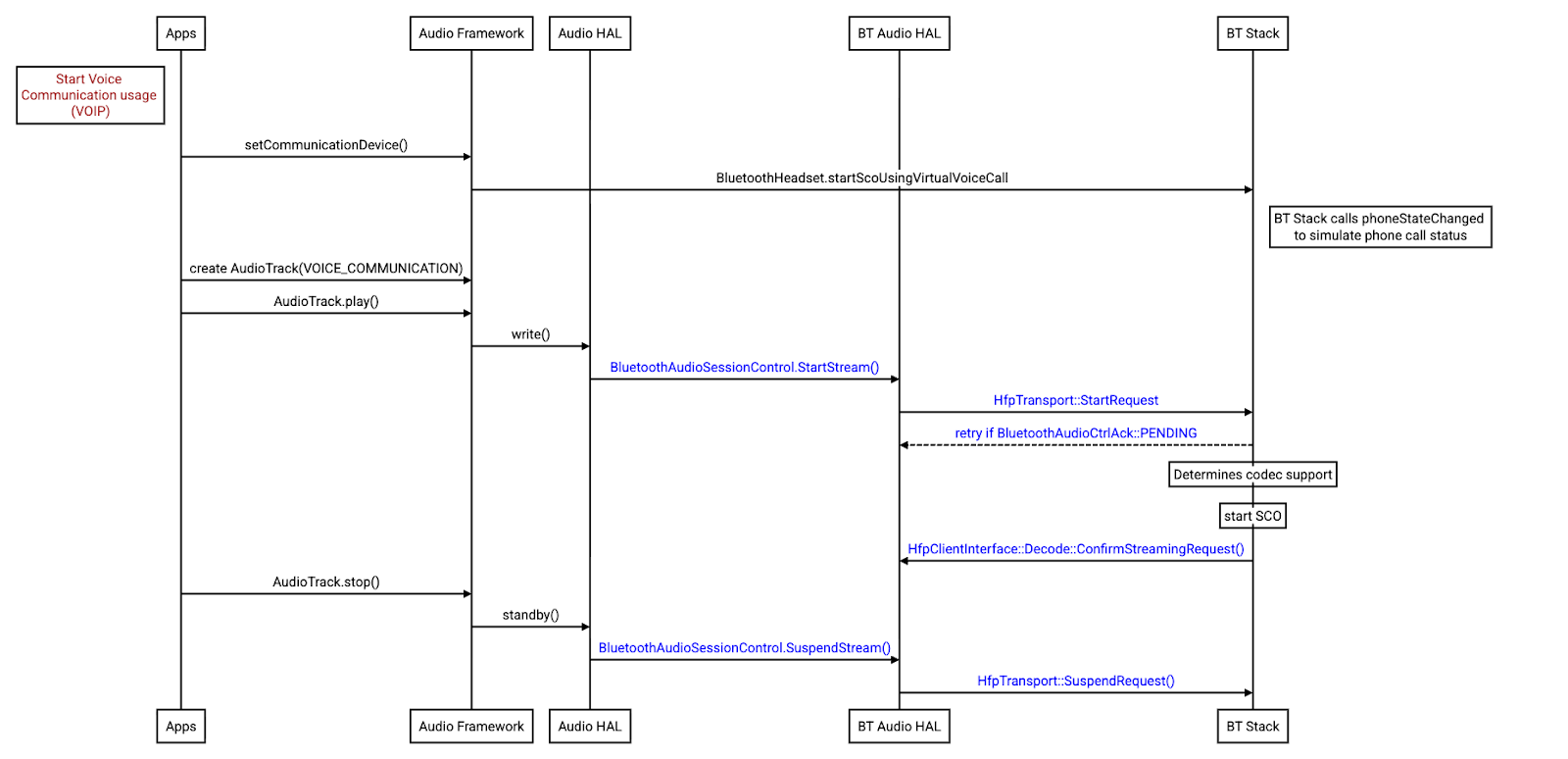
Figure 6. Answer or start a call through VOIP.
Voice recognition
For both hands-free (HF) and AG initiated voice recognition, the BT stack must
request the audio framework to open SCO using
AudioManager.setCommunicationDevice. This is illustrated in the following
figure:
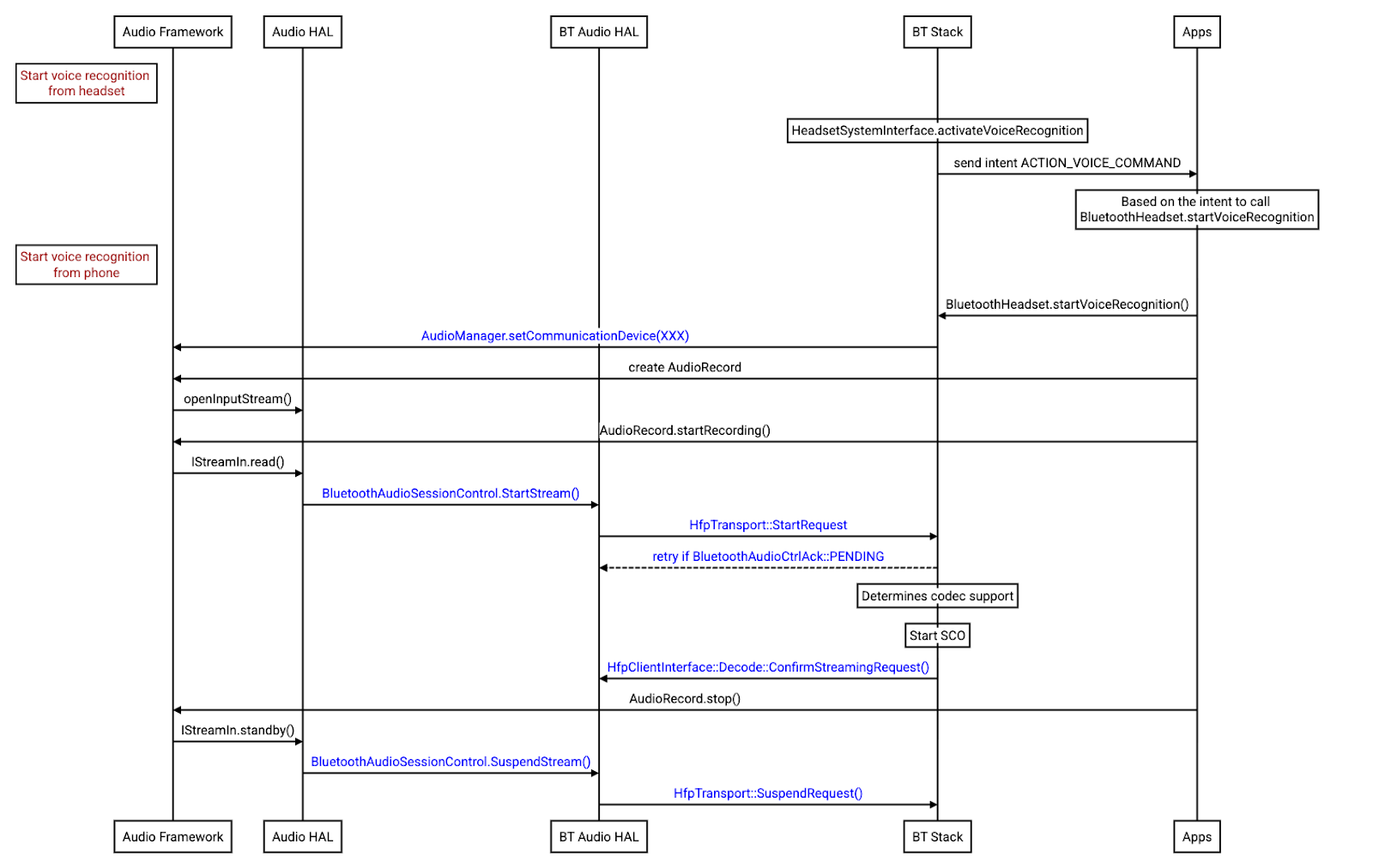
Figure 7. Voice recognition SCO initiation.
Audio connection
The BT stack initiates an SCO connection by requesting the audio framework with
AudioManager.setCommunicationDevice(AudioDeviceInfo) during voice
recognition. If a call is active, the BT stack instead requests
BluetoothInCallService#requestBluetoothAudio from the telecom stack.
This process is shown in the following figure:
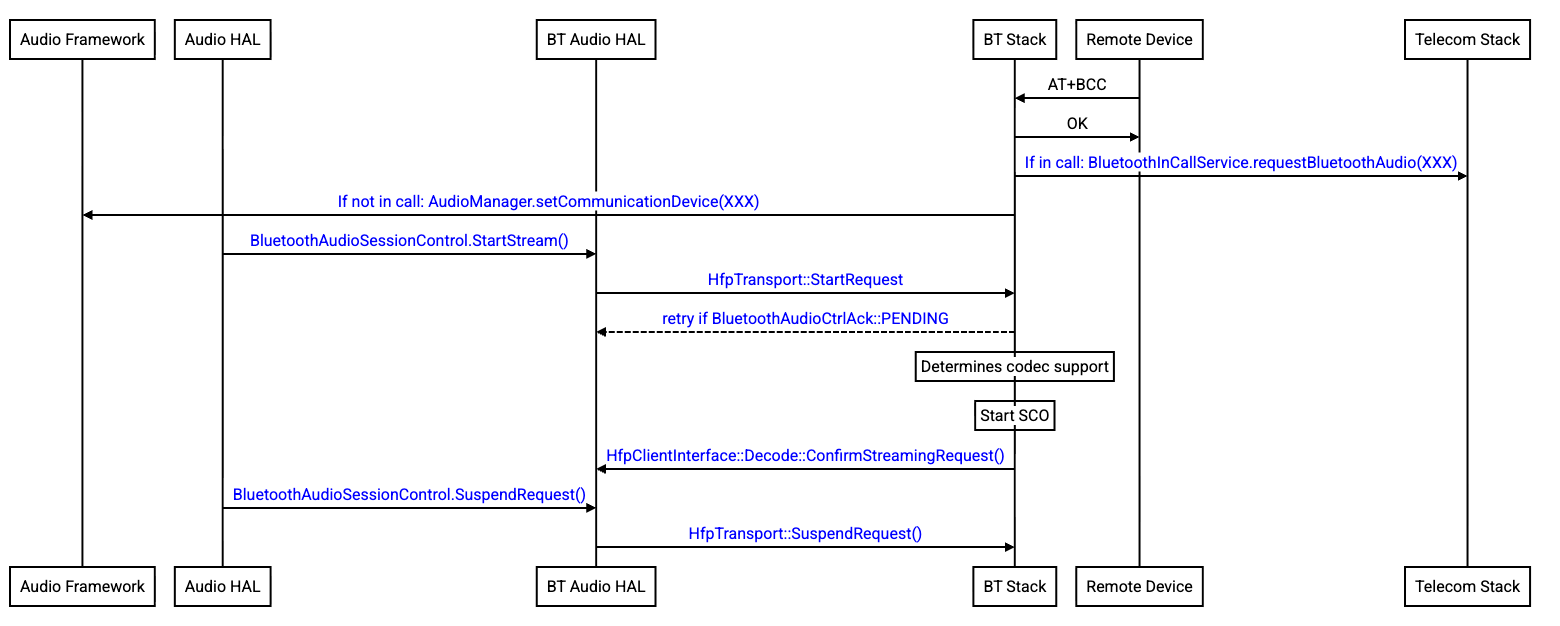
Figure 8. Audio connection.
Validation and testing
To validate that the feature is correctly integrated and meets quality standards, device manufacturers must run the following tests:
- CTS Verifier: Use the CTS Verifier for interactive testing of audio routing during calls.
- Vendor Test Suite (VTS): Validate the AHAL and BT AHAL interactions using VTS.
Requirements
This feature is subject to the following requirements:
- AHAL: Implementation requires a compatible AHAL that supports the refactored SCO management path.